


HAVEN:
SPIRITUAL SPACE: AN INTERVIEW WITH ANDREW MANN
24 February 2026

As we flew into 2026, I paused to consider how we might live and design from a more heart-centered space this coming year. How we might focus, with intention, on the relational aspect of our work as well as the spirit of the spaces we’re creating. While everyone might approach this differently, the essence lies in creating meaning…both in our relationships and in what we do.
I’ve admired Andrew Mann for such a long time. He is simply one of my favorite architects, and people. His work is thoughtful, intentional, and deeply imbued with meaning. This month, I had the opportunity to tour one of his latest projects, the Wat Khmer Kampuchea Krom temple in San Jose, and it was truly a gift. Though still under construction, it is obvious that this is a project of the heart."


Set in a residential neighborhood in San Jose, this traditional Cambodian Buddhist temple complex is designed as a sanctuary for the community—the result of a long-cherished vision of philanthropist Lyna Lam, founder of the non-profit A Khmer Buddhist Foundation, who came to the United States as an immigrant and built a life here filled with family and community. The temple is both a gift to the community she has built here and a message of love to her homeland, and it is beautiful on every level. Designed for ritual and prayer, the temple lies at the heart of the complex, surrounded by community buildings and landscaped gardens. As Andrew toured me through the site, his deep commitment to authenticity was clear. He described his process as a bridge between people, culture and place—an ongoing conversation between the spiritual and architectural traditions of Cambodia, and the land and place of California.
Throughout our tour, I was in awe of both the work and the people who are bringing it to light. I hope you enjoy the conversation.

Bringing to light what is meant to be."
MQ: This project is such a unique opportunity. How do you approach the design of a sacred space?
AM: From the beginning, this project has not only been a place of devotion, but a vessel for culture and tradition. These are forms, shapes and materials that have been used by the Khmer culture for over a thousand years. It is amazing to be part of that extended history, and we have been meticulous in our respect for the significant architecture of the past.


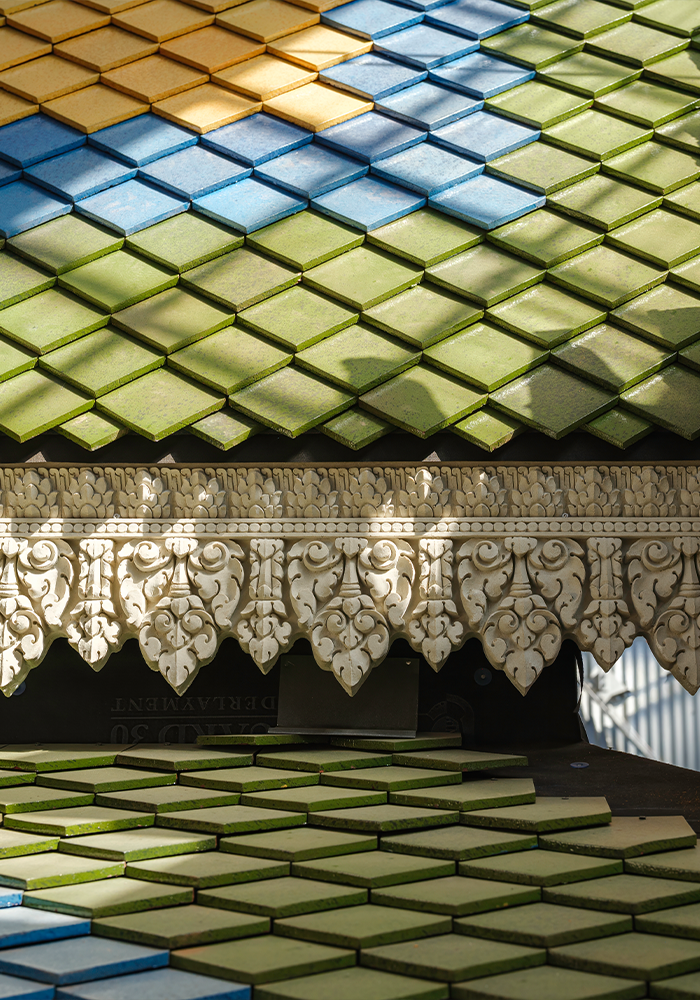
We are part of an architectural continuum that spans fifteen hundred years."
MQ: I feel honored to be here. Every space is crafted with such intention.
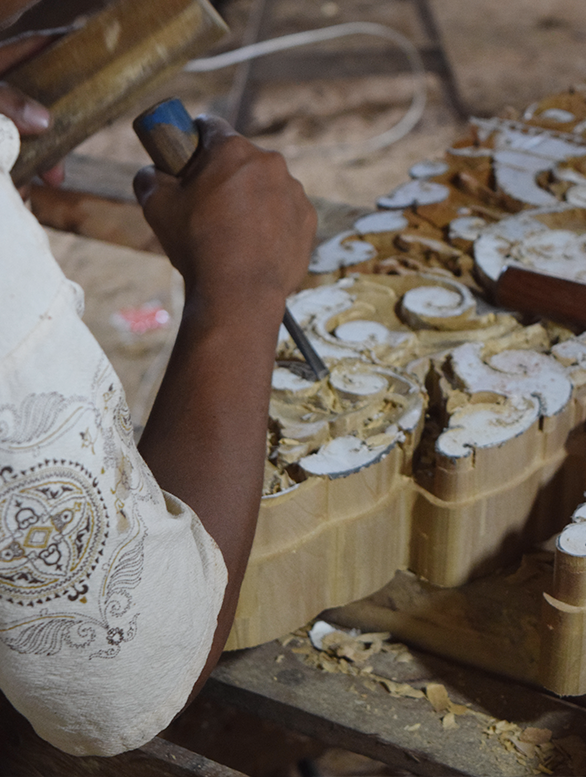
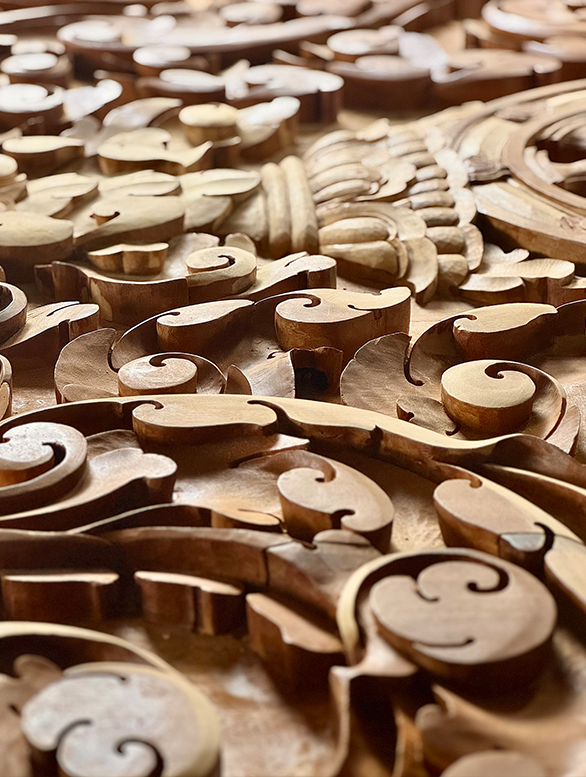
AM: Authenticity was incredibly important. The decorative elements on the temple draw inspiration from Banteay Srei, a 10th-century Hindu temple near Angkor. Our client’s mission was to have all of the decorative elements designed and crafted in Cambodia. Our partnership with AO Architects in Cambodia and with local craftspeople became a bridge between the traditional heart of the project and its location in California.
MQ: As we enter the site, I can already feel the energy.
AM: We’ve designed a symbolic portal that acts as the threshold between the secular and the sacred. Behind that portal, we’ve composed a collection of buildings and courtyards, connected by landscaped gardens designed by Strata.
MQ: This project is tucked into a residential neighborhood. How did you address that?
AM: In Khmer tradition, as the most important structure on the site, the temple was raised above the ground plane. We took advantage of the sloping site to create a plinth that elevates the building from the street. Yet because of the slope, it’s tucked into the site and directly connected to the community buildings behind it. The community buildings feel more residential, with more subdued details and roof-lines that help reduce the sense of scale, but they remain true to traditional Cambodian wood architecture.
MQ: The interior detailing in the temple is exquisite.
AM: The interiors, designed by Antonio Martins, are inspired by traditional Buddhist temples found throughout Cambodia. A mural telling the story of the life of Buddha will wrap the interior of the temple, crafted with traditional painting processes in a style inspired by the Silver Temple in Phnom Penh. Ceilings will be covered in intricate stencils in red and gold, and the floors laid with intricate floor tile patterns, all crafted in Cambodia. A statue of the seated Buddha will sit at the far end, facing east— the Buddha always faces east toward the rising sun.
MQ: You have built such trust with your client, and with your extended team. I can’t think of a more heart-centered project, or place.
AM: What is so meaningful about this project is that it is a love letter to our client’s homeland. She created a life here for herself, her family and for her extended community, and this project is a gift to serve the Khmer community that has grown here.
It’s about spending time getting to know the land, and listening to the client’s experience on the land, or in the region."


MQ: How has this project informed your other work?
AM: It’s opened me up to different ways of thinking. I’ve always loved classical architecture, but there are so many types of classical architecture, and with this project I’ve learned an entirely new language. It has pushed my team to a whole new level of detail and intentionality. It’s been a gift.
MQ: It’s a gift that has moved you both professionally and personally.
AM: It is fascinating to study and learn about another culture. I was fortunate to be able to meet with the head monk of Cambodia, and it was an incredible experience. This experience has encouraged me to lean into my own spiritual life.
MQ: This work is so unique. Are there any other similar temples in the United States?
AM: There is one in Minnesota. It was interesting to study. They used a different approach, bringing artisans to the site to work their craft. Our approach was to have the artisans do their work in place, then transport the elements here. Differing approaches, but with the same goal.
MQ: In the United States, I feel like we are starved for meaningful third spaces.
AM: As my practice continues to evolve, I’ve become more attuned to the feelings I want the architecture to evoke, whether in a spiritual space, a home or some other structure.
MQ: Is there anything else you would like the world to know about this work?
AM: For me, this is the most important building I’ll ever design. A project like this has allowed me to be a part of a gift to the community, part of a selfless act of the heart.
MQ: And through it, you are blessed as well.
AM: I absolutely am.